


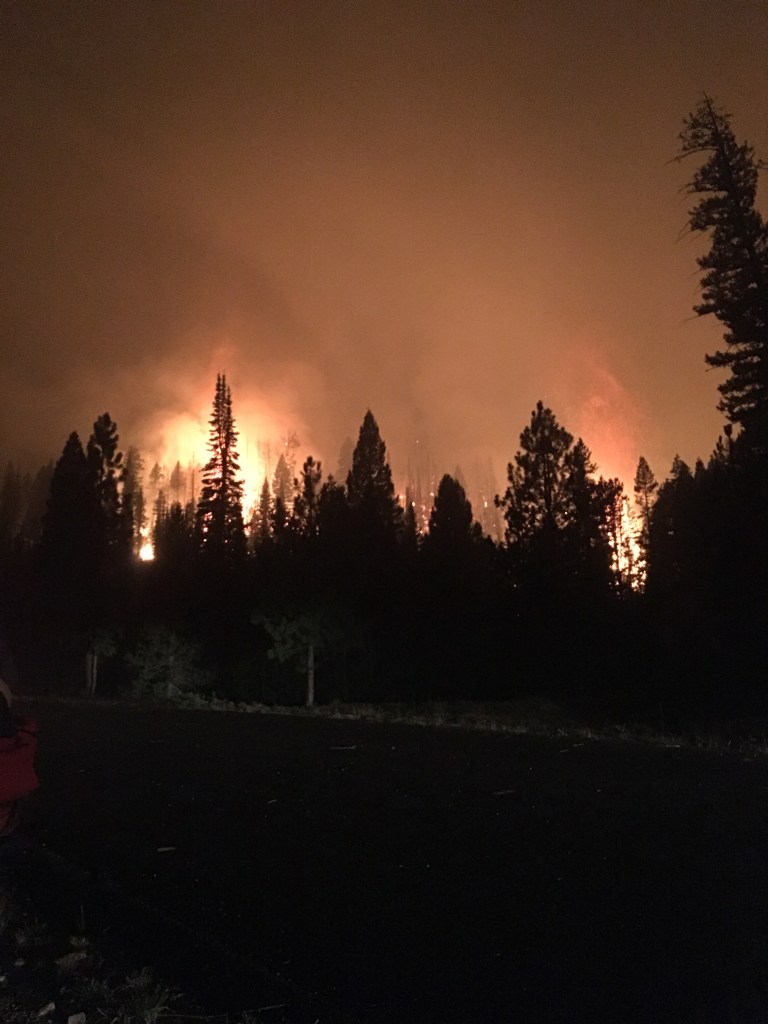

Welcome to the Thursday edition of Smoke Signals & Sarcasm. It’s June 18, 2026, and while you’re trying to mentally check out for the weekend and figure out if anyone will notice if you leave at 2:00 PM tomorrow, the wildland fire maps have officially entered maximum operational chaos. Mother Nature has skipped right past the gentle heat wave and gone straight to a high-speed atmospheric furnace.
Here is your adulting reality check on the Western fire situation for Thursday, June 18, 2026.
Thursday, June 18: The “Data Disconnect & Dry Lightning” Report
National Preparedness Level: 3 out of 5
Translation: We have officially bumped up to a Level 3. This is the internal equivalent of your phone battery turning yellow and dropping into low-power mode, except your manager just handed you a massive pile of new projects due by Friday at 5:00 PM. We are managing 27 uncontained large fires, and overall personnel has surged by over 1,000 resources since yesterday.
The Western Burn Book: Today’s Main Characters
Think of today’s incident list like your corporate Slack channels—some groups are completely quiet, while others are spamming everyone with emergency notifications.
| Incident Name | Reporting Agency | Reported Size (Acres) | Current Fire Behavior |
|---|---|---|---|
| South Fork Fire | Nebraska NF (USFS) | 39,057 Acres | Minimal / Flanking & Creeping |
| Tule Rd Fire | Yakama Agency (BIA) | 23,944 Acres | Minimal / Creeping & Smoldering |
| Quarry 2 Fire | Florida FS (ST) | 15,900 Acres | Extreme / High-Speed Running |
| Juniper Dunes Fire | Spokane BLM (BLM) | 13,003 Acres | Minimal Fire Behavior |
| Bear Fire | Gila NF (USFS) | 7,769 Acres | Moderate / Single-Tree Torching |
| Rock Canyon Fire | Arizona DOF (ST) | 4,512 Acres | Extreme / Long-Range Spotting |
| Roza Fire | Spokane BLM (BLM) | 3,923 Acres | Active / Running Through Brush |
- Nebraska’s Looming Giant: The South Fork Fire near Crawford, NE, remains the giant of the map, holding firm at 39,057 acres. It’s currently 80% contained and showing minimal behavior, but evacuations and road closures are still firmly locked down while houses are actively threatened. It’s the project that’s mostly finished but still requires you to keep checking your emails over the weekend.
- The Northwest Outbreak: Washington state is having an absolute breakdown, logging 4 brand-new large incidents yesterday alone. The Kartar Fire exploded to 7,500 acres with 0% containment, threatening structures and triggering immediate evacuations. Meanwhile, the Roza Fire near Selah is sitting at 3,923 acres and is actively running through brush and grass, making a direct run at local power grids and energy infrastructure.
- The Great Basin Disconnect: If you look at the live data feeds, the Rock Canyon Fire on the Arizona Strip shows up at 4,512 acres, while the morning paper lines have it at 2,500 acres. This is classic bureaucracy lag—the fire is expanding much faster than the database can update. It is showing extreme behavior with group torching and long-range spotting.
- Florida’s Massive Sprint: Proving that the East Coast can cause a scene too, the Quarry 2 Fire near Doral, FL, expanded by a wild 12,400 acres in a single day, ballooning to 15,900 acres. It’s showing extreme running behavior, and mandatory evacuations are actively in effect.
- The “Clocked Out Early” Club: Let’s hear it for Washington’s Twin Sisters Fire (8,262 acres) and Alaska’s Bonanza Fire (427 acres), which officially hit 100% containment! Crews turned in their gear, closed their laptops, and are officially unreachable until Monday morning.
The Weather: “Sierra Blow Dryers & The High-Based Threat”
Meteorological updates indicate a major breakdown of the western ridge as a midlevel trough crosses northern California:
- The High-Based Hazard: Large-scale atmospheric forcing is bringing midlevel moisture over deeply mixed, bone-dry valley surfaces. Translation: Widely scattered dry thunderstorms are breaking out across northern California, the Great Basin, and the Intermountain West. Because the atmosphere is basically an oven, the rain will evaporate before hitting the soil, leaving behind nothing but cloud-to-ground lightning ignitions and erratic, violent wind outflows.
- The Double-Digit Dryer: Ahead of the storm tracks, southwesterly winds of 15–20 mph are combining with relative humidity tanking down into the 10% to 15% range. The Desert Southwest is staring down triple-digit heat up to 110°F. It’s the ultimate atmospheric blow dryer setting.
Idaho Fire Pro-Tip: The Hot Muffler Duff Trap
If you are heading out to clear brush, cut firewood, or clear trail blockages on your property this weekend, let’s talk about your chainsaw placement. A working chainsaw muffler quickly reaches temperatures exceeding 700°F. When you drop your saw onto the ground to move a log, clear a branch, or take a quick water break, do not place it directly onto dry pine needles, leaves, or duff. It takes less than five seconds of contact with a blistering metal engine block to start an underground smolder that flares into an active wildfire the moment you walk away. Find a bare rock, a clean dirt patch, or keep it inside a designated container when it’s sizzling hot. Keep the heat in your engine and off our incident reports.
Leave a Reply